
What Does the Gleason Score Mean in Prostate Cancer?
When a man is diagnosed with prostate cancer, one of the first medical terms he is likely to encounter is the “Gleason score.” It appears on the pathology report after a prostate biopsy, and it plays a central role in deciding how aggressive the cancer is and what treatment path makes sense. For many patients, the score is confusing — a pair of numbers added together, described with unfamiliar terms like “patterns” and “grade groups.” This blog breaks down what the Gleason score actually measures, how it is calculated, and why it matters.
What Is the Gleason Score?
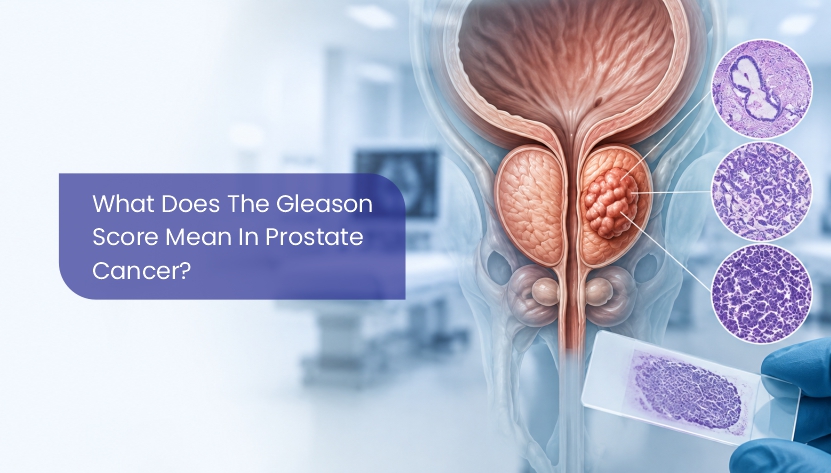
The Gleason score is a grading system pathologists use to describe how abnormal prostate cancer cells look under a microscope compared with normal prostate tissue. Developed by Dr. Donald Gleason in the 1960s, it remains one of the most reliable predictors of how a prostate cancer is likely to behave — whether it will grow slowly or aggressively and how likely it is to spread beyond the prostate. The more the tissue has lost its normal glandular structure, the higher the grade, and the more aggressive the cancer is considered to be.
How Is the Score Calculated?
During a biopsy, small tissue samples are removed from different areas of the prostate. Because a tumor often contains more than one pattern of cancer cells, the pathologist identifies the two most common patterns and grades each from 1 to 5:
- Grade 1–2: Cells look almost normal and well organized (rarely reported on modern biopsies)
- Grade 3: Still recognizable as glands, but more irregular and infiltrative
- Grade 4: Poorly formed, fused, or barely resembling glands
- Grade 5: Little to no glandular structure; sheets or clusters of abnormal cells
The grades of the most common and second most common patterns are added together to give the Gleason score — for example, “3 + 4 = 7.” Order matters: a score written as 3 + 4 is generally less aggressive than 4 + 3, because it indicates which pattern is more dominant.
What Do the Numbers Mean?
- Gleason 6 (3 + 3): Low-grade; tends to grow slowly
- Gleason 7 (3 + 4 or 4 + 3): Intermediate-grade; behavior varies by which pattern dominates
- Gleason 8 (4 + 4, 3 + 5, or 5 + 3): High-grade
- Gleason 9–10: Very high-grade, with greater likelihood of aggressive behavior and spread
Grade Groups: A Simpler Way to Understand Risk
Because a Gleason score of “6 out of 10” can sound like it's in the middle of the severity scale — when it's actually the lowest grade typically reported — pathology reports now often include a simpler five-tier Grade Group alongside the traditional score:
- Grade Group 1 = Gleason score 6 or less
- Grade Group 2 = Gleason 3 + 4 = 7
- Grade Group 3 = Gleason 4 + 3 = 7
- Grade Group 4 = Gleason 8
- Grade Group 5 = Gleason 9 or 10
Why the Gleason Score Matters for Treatment
The Gleason score, combined with PSA level and clinical stage, helps classify prostate cancer into risk categories — very low to very high risk — which guides whether active surveillance, surgery, radiation, hormone therapy, or a combination is most appropriate. A man with a low Gleason score, low PSA, and a small amount of cancer on biopsy may be a good candidate for active surveillance, avoiding treatment side effects for a cancer that may never cause harm. A higher Gleason score, on the other hand, often prompts more immediate treatment because the cancer is more likely to grow and spread.
A Number, Not the Whole Picture
The Gleason score is one important piece of a larger puzzle. Doctors also weigh PSA levels, MRI findings, the number and percentage of biopsy cores involved, genomic testing in some cases, and the patient's age and overall health. Two men with the same Gleason score may be offered very different treatment recommendations based on these other factors.
Conclusion
If you or a loved one has recently received a pathology report with a Gleason score, the most useful next step is a detailed conversation with a urologist or oncologist help interpret that number in the context of your full clinical picture and map out the options that make sense for you.
Contact Us
The Gujarat Uro Oncology Associates team offers expert consultation, diagnosis, second opinions, and treatment planning for urological cancers. To learn more or book an appointment, contact 91 75730 04253 or email bakshihemang@yahoo.co.in.