
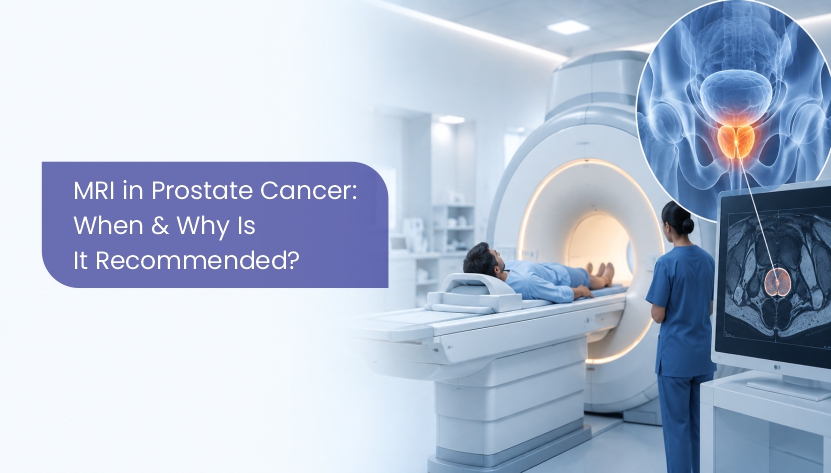
MRI in Prostate Cancer: When and Why Is It Recommended?
Magnetic resonance imaging (MRI) has become one of the most valuable tools in the diagnosis and management of prostate cancer. While prostate biopsies were once performed somewhat blindly across the gland, modern MRI allows doctors to see suspicious areas before a needle is ever used. This blog explains what an MRI can show, when it is typically recommended, and how it fits into the broader prostate cancer care pathway.
What Makes Prostate MRI Different?
A standard prostate MRI used for cancer evaluation is usually a multiparametric MRI (mpMRI), combining several imaging sequences to build a detailed picture of the prostate. Radiologists interpret these images using a standardized system called PI-RADS (Prostate Imaging Reporting and Data System), assigning scores from 1 to 5 to suspicious areas:
- PI-RADS 1–2: Very low to low likelihood of clinically significant cancer
- PI-RADS 3: Equivocal; findings are indeterminate
- PI-RADS 4–5: High to very high likelihood of clinically significant cancer
When Is an MRI Recommended?
MRI is used at several different points along the prostate cancer journey:
- Before an initial biopsy: To identify suspicious regions and guide a targeted biopsy, or to help some men safely avoid or delay biopsy altogether
- To guide a targeted biopsy: MRI-ultrasound fusion biopsy directs needles precisely to suspicious areas rather than sampling randomly
- For staging after diagnosis: To assess whether a tumor appears confined to the prostate or extends beyond the capsule
- During active surveillance: Periodic scans help track whether a low-risk tumor is growing or changing over time
- To plan treatment: Surgeons and radiation oncologists use MRI to understand the tumor's exact location and extent
- To evaluate possible recurrence: MRI can investigate a rising PSA after treatment by looking for signs of cancer near the prostate bed
Why MRI Has Become So Important
Before MRI was widely used, biopsies were typically performed in a systematic pattern across the gland without any imaging guidance — meaning some clinically significant cancers could be missed while low-risk cancers were sometimes overtreated. By identifying suspicious regions in advance, MRI-guided approaches improve detection of higher-grade, clinically significant cancers while reducing detection of very low-risk disease. This helps reduce both unnecessary biopsies and unnecessary treatment, which matters given the real side effects biopsy and treatment can carry, including infection risk, urinary symptoms, and sexual dysfunction.
What to Expect During the Scan
A prostate MRI is non-invasive and painless, though it requires lying still inside the scanner for roughly 20 to 45 minutes. Some centers use intravenous contrast to improve image quality, and men are typically asked to avoid ejaculation for a day or two beforehand, as this can temporarily affect how the prostate appears on imaging. Unlike biopsy, MRI carries no risk of infection or bleeding.
Limitations to Keep in Mind
MRI is powerful but not perfect. Some clinically significant cancers do not show up clearly, and not every suspicious area seen on MRI turns out to be cancer on biopsy. Image quality can also vary with equipment and radiologist experience. For this reason, MRI results are always considered alongside PSA levels, clinical exam findings, and biopsy results — never in isolation.
Conclusion
If your doctor has recommended an MRI as part of your prostate cancer evaluation, it generally reflects an effort to gather the most precise information possible before recommending a biopsy or treatment plan — a reflection of how far prostate cancer diagnostics have advanced.
Call to Action
Wondering if a prostate MRI is right for you? Book a consultation with our uro-oncology team today.
Contact Us
The Gujarat Uro Oncology Associates team offers expert consultation, diagnosis, second opinions, and treatment planning for urological cancers. To learn more or book an appointment, contact 91 75730 04253 or email bakshihemang@yahoo.co.in.